


THE ARCHIVES
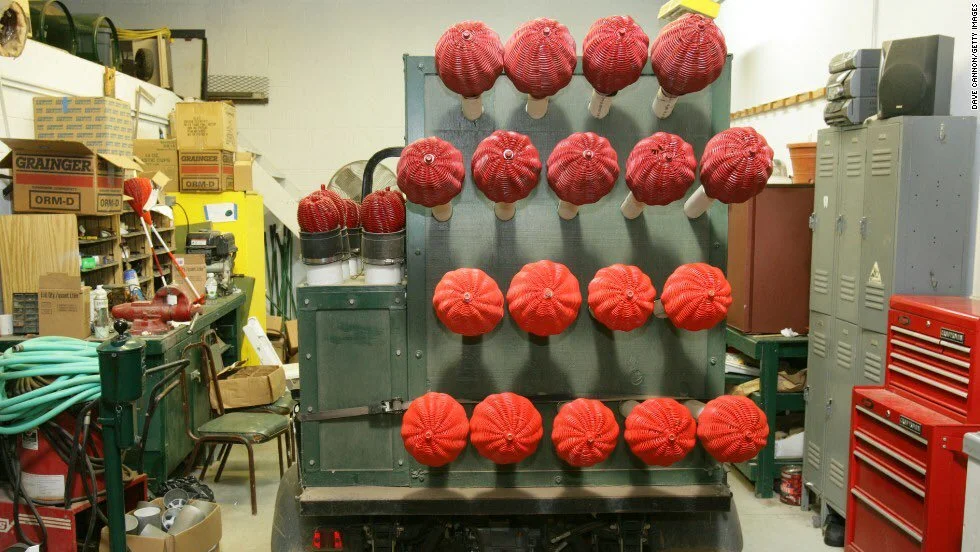
Walls That Talk
Golf Magazine dives deep into Merion Golf Club’s 1824 Farmhouse Archive’s, in this Youtube feature below.
An amazing look inside one of golf’s true cathedrals, and at one of the sport’s most famous Members Terrace’s.
-The Committee
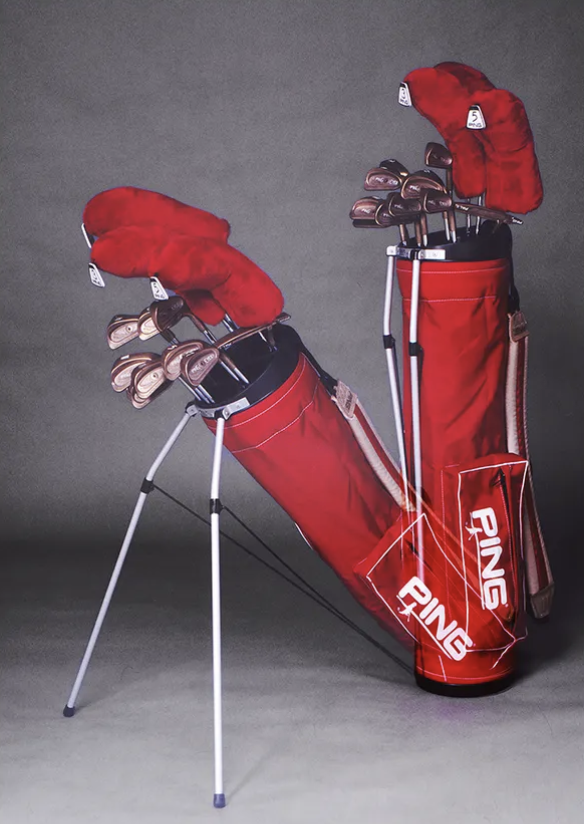
The Bag That Fell Four Feet
Photo Source: Golf.com
A history of the PING carry bag — and how to know an original when it's standing in front of you.
Golf remembers its clubs and forgets its bags. The putter that dropped the winning stroke gets the plaque; the thing that carried it up eighteen fairways gets thrown in a garage. We think that's backwards. The carry bag is the one piece of equipment a walking player touches on every hole, and for a certain stretch of years PING made the definitive one. This is the history of the PING golf bag — from the 1988 L8 to the Hoofer — and a field guide to authenticating a vintage original.
A putter company that backed into bags. PING began in a garage. Karsten Solheim, an engineer at General Electric, started shaping putters at home in the late 1950s and left GE in 1967 to build the company outright. The name came from the sound a milled head made against a ball. For roughly three decades the identity was built on that sound: the Anser putter, the perimeter-weighted EYE2 iron. Bags were nowhere near the center of it. That PING would eventually own the carry-bag category was not obvious in 1970 — it happened because one of Karsten's sons went looking for a problem worth solving.
The stand that fell four feet. PING did not invent the stand bag. A British maker had bolted legs to a carrier back in the 1890s, and the results were heavy, awkward things. What PING did, in the late 1980s, was reinvent it. The youngest Solheim son, John, took up the problem and worked it down to something light — aluminum legs, a pared-back spring, nothing wasted. The proof was almost theatrical: drop the bag from four feet, and when the base struck the ground the legs would kick open and catch it upright. The patent for that mechanism was filed on 5 July 1988 and granted on 30 May 1989 — the paper trail underneath everything that followed.
The L8, and the blueprint. The first carry bag PING built on that stand was the L8, in 1988 — the company's first bag with retractable legs. Everything the category now takes for granted, the L8 did first. Single strap. Four-way top. A silhouette stripped to what a walker actually needs and nothing else. PING still describes the lineage as the design that set the standard in carry bags more than thirty years ago, and it is not marketing to say so. It was genuinely the template. Collectors treat a clean original L8 accordingly — not as an old bag, but as the first of its kind.
Sold in the rain. A good product still needs a first believer. PING's was a college team. Oklahoma State had been the first program PING equipped, back in 1976, so when John Solheim wanted to reach younger players he went back to Stillwater. The team didn't want it. To a nineteen-year-old in the late '80s, a bag with legs read as something an old man carried. A PING rep contacted head coach Mike Holder, who agreed — reluctantly — to bring the bags on a two-tournament swing through Hawaii. One player finally tried it before a final round. Then it rained. His clubs came up dry while his teammates' didn't, and by the next event the whole squad had switched. As the top-ranked team in the country, they were the only advertisement the bag ever needed.
The Hoofer, and the shape of a hoof. The original stand had one flaw: material at the bottom could fold in as the bag opened and snag a club. John Solheim's fix was geometric. He made the top and base oval rather than round, which cleared the catch below and opened the mouth above. The shape reminded him of a hoof, and the name followed. PING’s own catalogue makes the case in working terms: the hoof-shaped bottom gives more separation for the grips at the bottom of the bag, and a shape that rests comfortably against the golfer’s body while it is carried. The Hoofer arrived in 1996 and never really left — it became the most-carried stand bag at the men's and women's NCAA Division I Championships for three decades running. Its maker's own verdict was plain: "It's, by far, the best thing I did in my career." For our purposes the Hoofer matters most as the thing an L8 is not. The oval base is the fork in the road.
What came after. PING did what it usually does with a winner: it iterated quietly rather than replacing it. The Hoofer spun off lighter versions, a fully waterproof Monsoon, and a fourteen-way variant, while cart and staff bags filled out the range. Most updates over the years were low-key by design — new colors, revised pockets, better materials — with the occasional real advance like backpack straps. The restraint is the point. When the original is right, you leave it mostly alone.
How to know an original. We authenticate by letting the object testify, and we use only the marks a document can stand behind. First, the base: turn the bag over and look straight down. A round base is L8 geometry. An oval base is a Hoofer. That tell settles the model and it cannot be talked around. Second, the top and the straps, read against the books: PING's 1996 catalogue lists the L8+ with one padded shoulder strap, and the Hoofer with a single- or dual-strap system as standard equipment, so a factory double-strap L8+ belongs to a later line than that one. Third, the fittings: compound-bend legs are post-2007, and a Leg Retention System present with retractable straps absent puts a bag at 2012 or later. As for the saddle-tan Karsten patch, read it as a maker's mark rather than a clock — the address embossed on it is the company's address of record and sits unchanged across long runs of filings, so it tells you who made the bag, not when. Date the bag from its base, its legs, its straps and its top.
A raw L8 changing hands online is a commodity. The same bag, read correctly and presented with its papers in order, is the reference example of the first stand bag that mattered. The difference between the two is only ever attention — and attention is the whole business we're in.
— Three Cypress Club
Common Questions
When did the PING L8 golf bag come out?
The PING L8 arrived in 1988 — the company's first carry bag with retractable legs, and the template most modern stand bags still follow.
How do you tell a PING L8 from a Hoofer?
The base settles it. A true round base is the original L8 — pre-Hoofer geometry. An oval base is a Hoofer, which PING introduced in its 1996 line. PING’s own reasons for the hoof-shaped bottom: more separation for the grips at the bottom of the bag, and a shape that rests against your body while you carry it.
How do you date a vintage PING golf bag?
Date it from the object, not the address. Turn the bag over first: round is L8 geometry, oval is a Hoofer. Then read the fittings against the books: PING’s 1996 catalogue lists the L8+ with one padded shoulder strap and the Hoofer with a single- or dual-strap system, so a factory double-strap L8+ belongs to a later line than that one. Compound-bend legs are post-2007, and a Leg Retention System with no retractable straps puts a bag at 2012 or later. The embossed Karsten patch is a maker’s mark, not a clock: the address on it is the company’s address of record and sits unchanged across long runs of filings. Reissues carry no embossed Karsten patch at all.
Is the PING L8 still made?
PING has reissued the L8 as a heritage model (in 2013, and again around 2020–21), but those are modern bags. A genuine vintage original is Karsten-era, identified by its embossed Karsten leather patch and round base.
Sources
PING, And the Putter Went PING (official company history / book) — https://ping.com/en-us/shop/gear/miscellaneous/and-the-putter-went-ping-leather-edition
Sean Zak, "Ping's pioneering Hoofer stand bag has kept golfers upright for 3 decades," GOLF.com (2024) — https://golf.com/gear/golf-accessories/ping-hoofer-stand-bag-3-decades/ — (four-foot drop test, Oklahoma State rain story, oval-base "hoof" refinement, John Solheim quote)
"A good walk made simple," Sports Illustrated Golf (2018) — https://www.si.com/golf/travel/feature-2018-01-17-a-good-walk-made-simple — (L8 as first carry bag with retractable legs; corroborating OSU account)
"PING Golf Bags: 6 Of The Best Models To Consider," MyGolfSpy (2023) — https://mygolfspy.com/buyers-guide/ping-golf-bags-6-of-the-best-models-to-consider/ — (Hoofer line extensions; DLX cart bag)
"Ping Hoofer Monsoon Golf Carry Bag Review," National Club Golfer (2025) — https://www.nationalclubgolfer.com/reviews/bags/ping-hoofer-monsoon-golf-carry-bag-review-thoughtful-and-brilliant-design-features/ — (Hoofer range dated to 1993; "hoofing it" name origin; low-key iteration)
Jeffery B. Ellis, And The Putter Went… PING (Zephyr Productions, 2017), ISBN 9780965303965 — https://www.amazon.com/Putter-Went-PING-Standard-Jeffery-Ellis/dp/0965303969 — (the definitive company history; ~530 pages, ~1,000 photographs; primary-source imagery and interviews